Richard Lambert is an experienced composer, organist and conductor. He is a former Senior Examiner, Trainer and Moderator for the London College of Music at the University of West London.
His compositions have been performed in the UK, Europe, North and South America, Africa, S.E. Asia and Australia.
BIOGRAPHY
Richard Lambert combines a career as composer, examiner, organist and conductor. His recent works include a second string quartet, a bassoon sonata (premiered in Cyprus), a euphonium sonata (premiered in Florida), ‘Gloria, laus et honor‘ – an organ toccata (premiered in LA), and an opera, The Yellow Dress, produced at the Tête-à-Tête opera festival in London.
"My catalogue is shamelessly eclectic in its mixture of styles, and yet, whilst absorbing many cosmopolitan influences, I still think of my compositional language as intrinsically English.
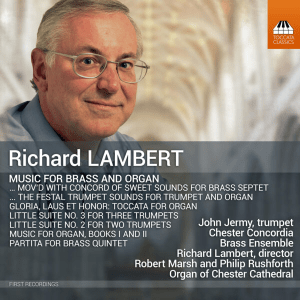
A BRASS AND ORGAN CD FROM RICHARD LAMBERT: ORGANISTS PHILIP RUSHFORTH AND ROBERT MARSH WITH CHESTER CONCORDIA BRASS
Listen to all the pieces via the relevant pages on this website or visit Toccata Classics website using the link below to hear extracts from the tracks and to purchase the CD.
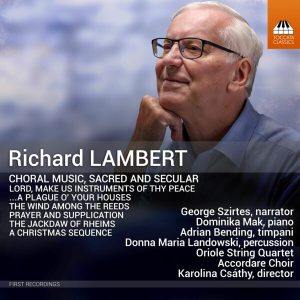
A CHORAL CD FROM RICHARD LAMBERT AND THE ACCORDARE CHOIR
Listen to all the pieces via the relevant pages on this website or visit Toccata Classics website using the link below to hear extracts from the tracks and to purchase the CD.
To help you find what you are looking for, my website has an extensive Search & Filter feature. This will allow you to find the music you’re interested in quickly and easily.
You can also use Filter by Instrument which can be found in the footer section of each page on the site.
We use cookies on our website to give you the most relevant experience by remembering your preferences and repeat visits. By clicking “Accept”, you consent to the use of ALL the cookies.
This website uses cookies to improve your experience while you navigate through the website. Out of these, the cookies that are categorized as necessary are stored on your browser as they are essential for the working of basic functionalities of the website. We also use third-party cookies that help us analyze and understand how you use this website. These cookies will be stored in your browser only with your consent. You also have the option to opt-out of these cookies. But opting out of some of these cookies may affect your browsing experience.
Necessary cookies are absolutely essential for the website to function properly. This category only includes cookies that ensures basic functionalities and security features of the website. These cookies do not store any personal information.
Any cookies that may not be particularly necessary for the website to function and is used specifically to collect user personal data via analytics, ads, other embedded contents are termed as non-necessary cookies. It is mandatory to procure user consent prior to running these cookies on your website.